
- Posts: 24
- Thank you received: 6
 how to make 4% hydrochloric acid out of 32% ?
- kentaurus
-
 Topic Author
- Offline
- Junior Member
-

Less
More
27 May 2016 02:55 #52344
by kentaurus
how to make 4% hydrochloric acid out of 32% ? was created by kentaurus
Hello!
How to prepare a 4% hydrochloric acid solution out of 32% of hydrochloric acid? Are there a calculator and instructions?
Thank you
How to prepare a 4% hydrochloric acid solution out of 32% of hydrochloric acid? Are there a calculator and instructions?
Thank you
Please Log in or Create an account to join the conversation.
- CLO2
-

- Offline
- Administrator
-

27 May 2016 07:04 #52346
by CLO2
Replied by CLO2 on topic how to make 4% hydrochloric acid out of 32% ?
Very carefully! High % HCL is dangerous stuff.
endmemo.com/bio/dilution.php use the last calculator set to %.
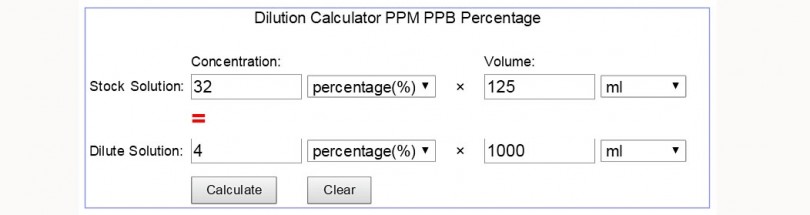
You will be adding 125 ml of 32% HCL to 875 ml of distilled water for a total of 1000 ml (1 liter) in this example. Be sure that you do NOT add water to acid! Wear eye and hand protection and do NOT breath the fumes. I suggest to do this dilution outside with the wind blowing the fumes away from you.
endmemo.com/bio/dilution.php use the last calculator set to %.
You will be adding 125 ml of 32% HCL to 875 ml of distilled water for a total of 1000 ml (1 liter) in this example. Be sure that you do NOT add water to acid! Wear eye and hand protection and do NOT breath the fumes. I suggest to do this dilution outside with the wind blowing the fumes away from you.
The following user(s) said Thank You: fourfingerz, kentaurus
Please Log in or Create an account to join the conversation.
- kentaurus
-
Topic Author
- Offline
- Junior Member
-
Less
More
- Posts: 24
- Thank you received: 6
28 May 2016 23:27 #52366
by kentaurus
Replied by kentaurus on topic how to make 4% hydrochloric acid out of 32% ?
Hi CLO2! Thank you for the tip.
So per the explanation I have to have water in the jar first and then I add the acid, not vice versa, correct? Is there an explanation why it has be in this sequence? I am just curious.
Do you have similar tips for diluting 99.98% DMSO, making 50% citric acid and diluting 80% Sodium Chlorite flakes/powder? E.g. are there any safety precautions for these ingredients like you did describe for the HCl?
So per the explanation I have to have water in the jar first and then I add the acid, not vice versa, correct? Is there an explanation why it has be in this sequence? I am just curious.
Do you have similar tips for diluting 99.98% DMSO, making 50% citric acid and diluting 80% Sodium Chlorite flakes/powder? E.g. are there any safety precautions for these ingredients like you did describe for the HCl?
Please Log in or Create an account to join the conversation.
- CLO2
-
- Offline
- Administrator
-
29 May 2016 02:04 #52368
by CLO2
Replied by CLO2 on topic how to make 4% hydrochloric acid out of 32% ?
If you add water to acid you may get a violent chemical reaction splattering dangerous 32% HCL onto you! That stuff will do serious damage to eyes and skin. ALWAYS add acid to water. You will notice the solution will get warm.
Use the same calculator when diluting DMSO. It is not dangerous, but will get warm when mixed with water. Don't think the order makes any difference, but you could add the DMSO to water.
To make 22.4% sodium chlorite solution (MMS) from NaCLO2 powder or flakes, read this and watch this.
Use the same calculator when diluting DMSO. It is not dangerous, but will get warm when mixed with water. Don't think the order makes any difference, but you could add the DMSO to water.
To make 22.4% sodium chlorite solution (MMS) from NaCLO2 powder or flakes, read this and watch this.
The following user(s) said Thank You: fourfingerz, kentaurus
Please Log in or Create an account to join the conversation.
- CLO2
-
- Offline
- Administrator
-
29 May 2016 03:09 #52369
by CLO2
Replied by CLO2 on topic how to make 4% hydrochloric acid out of 32% ?
This forum post contains safety precautions when handling/making/using various chemicals in the MMS world.
g2cforum.org/index.php/list/general-discussion/28675-safety-guidelines
g2cforum.org/index.php/list/general-discussion/28675-safety-guidelines
The following user(s) said Thank You: fourfingerz, kentaurus
Please Log in or Create an account to join the conversation.
Time to create page: 0.265 seconds
The MMS HEALTH RECOVERY GUIDEBOOK is Jim’s latest book. It provides the latest information on how to safely use MMS. Click the book image to order your copy today.
Jim's Blog
-
How does MMS affect bacteria in the body?
Published on: July 24, 2026
First facts, MMS does not kill friendly bacteria. What is the difference in useful bacteria and the harmful stuff? Well the feces of the useful bacteria is not poisonous and the feces of the harmful bacteria is poisonous and that is what makes one sick and causes the problems. Poisons have long chains of atoms …
-
MMS/CD and Plastics
Published on: July 12, 2026
Question: How does MMS interact with various plastics? Jim: In regards to your question about plastics, we really cannot give you a “sure bet” answer. This is because the world of plastics is vast, and like so many things in our environment, it’s difficult to know what is really what. To give you an idea, …
-
MMS/CD, Bacteria and Viruses
Published on: July 5, 2026
Question: Does MMS/CD kill bacteria and virus? Jim: Antibacterial drugs can sometimes stop bacterial [infections] diseases but medicine has yet to develop anything to stop viral infections. Thankfully, MMS/CD has been known to stop both viral and bacterial diseases. For either viral or bacterial infections, begin with the Starting Procedure and continue following the Health …
-
Importance of Following the Plan
Published on: June 27, 2026
Every week at least one new person approaches me with the question will MMS/CD help overcome some new disease. MMS/CD is an oxidizer that fits into the operation of the body in the exact right chemical balance to kill diseases and their poisons and eradicate heavy metals. Drugs must somehow attack the nucleus of the …
-
More is Not Always Better
Published on: June 9, 2026
In my books, there are times when one might need to take larger doses of MMS/CD. In Protocol 2000, for example you’ll find maximum dosage amounts. Some might take this to mean the more MMS one takes the better. But this is NOT necessarily so! More is not necessarily better, you need to listen to …
-
Nutritional Research Information
Published on: May 27, 2026
Note: The following was written by Jim around 2012, and we are putting it here as food for thought. The subject of “nutrition” in the world today, is quite subjective, with a wide range of factors weighing into this equation, such as how the food is grown, handled, stored, processed, etc. etc. In addition, we …